Tuesday, 29 January 2013

Case Study - Shooter


I decided to look at another conspiracy-crime thriller as a result of our team talk, we wanted to base our two minute opening of a thriller on this sub-genre so we each looked at a different film as research and inspiration for our final video.

Shooter was one of my choices, a conspiracy-crime, action thriller directed by Antoine Fuqua, starring Mark Wahlberg as an ex-marksman coming out of retirement as a plan to assassinate the president, only to find he is being double-crossed and framed for the crime, consequently he becomes the enemy of the state and a target on the run all the while attempting to find answers to track the real killer, find out who he is and why he has been set-up. The plot gives a great advantage for tension to be created through mystery, placing the audience in the same ambiguous position of the protagonist - this is also one of the common conventions of a thriller which appear in this film along with the narrative being centred around a crime, the attempted assassination and the protagonist seen in danger in more than one scene before the resolution - on the run from FBI as well the rogue secret private military company unit who framed him.
Micro elements are also combined efficiently to build suspense. In the opening scenes low volume sound, (both diegetic and non-diegetic) as well as slow editing/transitions are combined with a tendency of slow camerawork though this speeds up simultaneously to build suspense as it works towards a climax, this being the major turning point in the beginning of the film - the set-up. This is however altered effectively and frequently throughout the film to compliment the narrative and create suspense and/or excitement for the viewers when needed.

Case Study - Vantage Point


Vantage Point is a conspiracy-crime, action thriller. With some typical thriller conventions, Vantage Point is is  however a unique thriller focusing on the attempted assassination of the president from eight different perspectives or, 'vantage points'. One of the major, common generic conventions includes the narrative being centred around crime, exploring kidnapping, terrorism and assassination. There is no particular protagonist as the story is told and re-told from many different viewpoints however we see an intense situation of peril played back in more than one scene before the resolution - the attempted assassination of the president and the bombings are shown in each of the perspectives as it works toward a final resolution. This one important enigma is set up right at the beginning of the film instantly from the first viewpoint and only further complicated during the film only until it is finally resolved at the very end. The first perspective focuses on a neutral point of view to show what happens though this is a very effective opening scene as it immediately creates great tension and suspense. It does this by vaguely showing the issue which narrative is based around and keeps viewers asking questions wanting to find out more and watch on - and these questions are slowly answered as the film shows each perspective but with various twists throughout keeping the viewers in high anticipation for an end result. These elements are also combined with other features efficiently to place this film into another sub-genre of action. For example, editing is used very effectively to excite (specific) audiences with explosions and gun-shots etc. This is accompanied by fast-paced, loud diegetic sound (music) and quick cut transitions to thrill the viewers constantly through each vantage point.

This short clip shows the perspective of secret service agent, Thomas Barnes, though also shows two other characters who are later shown in more detail through their own vantage points - this is the second vantage point and still early on in the film showing the drama right after the catastrophic terrorist attack.

Case Study - Memento

Memento is a psychological/mystery thriller written and directed by Christopher Nolan though inspired and developed from Christopher's younger brother Jonathan Nolan's short story, 'Memento Mori'.
In terms of the narrative, memento falls into the sub-genres of psychological thriller and mystery thriller through the genre codes and characteristics/conventions.Common characteristics of this genre and its sub-genres include the narrative being centred around murder, the protagonist is fallible and has an weakness which is exploited by others, the protagonist is seen in peril before the resolution, theme of identity is partially part of the theme though the protagonist does actually know who he is. The viewers are also placed in an ambiguous situation as a series of important enigmas are unravelled from the opening scene through to the end.
Leonord Shelby is a sufferer from anterograde amnesia who is after the criminals who 'murdered' his wife though encounters various issues due to his condition. He tattoos his own body as notes for reminding himself what happens as he is unable to make new memories - however this weakness is exploited by the antagonist Natalie who uses this to get revenge for her boyfriend as well as by Teddy Gambell who uses him to 'make a little extra money'. He is shown in many different dangerous situations throughout the film as it works backwards to resolve the solution, this effect of showing the film in reverse places the audience in an ambiguous position and creates great suspense and tension for the viewers as they anticipate future, or in this case previous events.

Camera Angles

Sunday, 27 January 2013

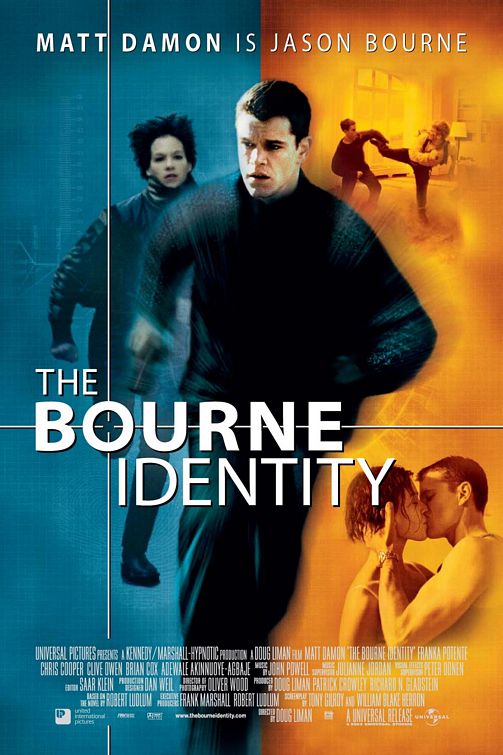
Case Study - The Bourne Identity


The Bourne Identity is a thriller directed by Doug Liman. It is a thriller which falls into the sub-genres of action, crime, and mystery. Common thriller generic conventions occurring in this film include the narrative of the film, centred around the crime of what was supposed to be the murder of 'Jason Bourne'. Themes of identity - Jason is picked up by a fishing boat and saved with the removal of a bullet only to wake with amnesia. An important enigma is set up in the opening which is further complicated only to be resolved towards the end (his identity). The plot of the film which is developed throughout is finding his identity, though this is only part of the narrative which is further explored through the antagonists. Protagonist Jason Bourne not only attempts to find out his true identity but also wants to find out who is after him and for what reason, this is a mystery to him as a sufferer from amnesia and he must encounter a number of obstacles to discover his identity and what he 'used to be' which explains why he is on the run, and from whom he is running.


Micro elements are also combined to develop the elements of a thriller. For example, in the opening scene the diegetic sound of the storm combined with the dark lighting instantly sets an atmosphere for the audience - we anticipate danger through the weather and perhaps even a factor of the unknown (implications of his identity) with the dark lighting. Another feature of editing is the camerawork, low angles are used frequently in the opening scene which also create a sense of mystery, the surroundings are hidden from the viewers which creates tension, an important element of thrillers, this keeps the audience asking questions and wanting to watch on and know what is happening/going to happen. Editing transitions are also adapted to build suspense, transitions are quite slow and nothing too exciting happens too early on however this is particularly effective with the alternatively contrasting loud music and sound which create excitement making it appear as though this is building to a dramatic composition. These features of micro elements are evident throughout the film - varying with the scene and atmosphere, handheld camerawork/steady-cam and fast pans as well as crane shots and quick-cut transitions are used during high action-packed scenes such as the car chase accompanied with loud diegetic and non-diegetic sound to create excitement whereas slower transitions are accompanied with low volume sound for the calm scenes building suspense. Here is the scene towards the beginning which i closely analysed:


Thriller

The three main elements of a thriller are suspense, tension and excitement used to 'thrill' an audience by giving the a high level of anticipation.'Thriller' is a genre in which many sub-genres can be developed. Some of these sub-genres include, action thriller, supernatural thriller, science fiction thriller, psychological thriller, religious thriller and crime thriller, The sub-genre (if there is one) is generally determined by the thriller genre conventions which are developed through characters, plot/narrative, themes and micro-elements.

action thriller: protagonist is commonly a male figured hero 'coming to the rescue' against a villain/antagonist. main factors of the film are violence and guns/explosives.(Fast Five/Skyfall)

supernatural thriller: generally supernatural with superheros saving the world from a super-villain, though the protagonist tends to have an 'Achilles Heel' which is exploited by the antagonist.(Batman Trilogy)

sci-fi thriller: a theory of erasing the human population or having erased the species, uses futuristic machinery/technology and CGI to target the niche audience. (Aliens/The Matrix)

psychological thriller: themes of the mind and perception/reality are common(Black Swan), another common theme is identity - protagonist may suffer from amnesia and try to discover who they really are (Unknown).
Mental issues/psychotic characters is also common amongst an antagonist or protagonist (Seven).

religious thriller: refers to religion, questions religious beliefs and goes into great depth to 'find out the truth' (The Da Vinci Code/Angels & Demons).

crime thriller: the plot centres around a crime such as theft or murder and 'investigates' to resolve the problem
(Pulp Fiction/Reservoir Dogs).

Tuesday, 22 January 2013

Prelim


Preliminary Task:
A continuity task involving filming and editing a character opening a door, crossing a room and sitting down in a chair opposite another character wit whom he exchanges dialogue . This should demonstrate: match on action, shot reverse shot and the 180 degree rule.

Before planning our preliminary task we began to look at the 3 main aspects of filming which needs to be included in our task:

180 degree rule:
- This keeps viewers perspective orientated
- It teaches that the actor should always be on the same side and the camera should not pass the '180° axis'
- However if u do switch the camera to 'break the rule' you must shoot the transfer            

Match on Action
- Refers to fluent editing between shots when changing the camera angle/shot

Shot Reverse Shot
- Switching between characters
- The camera generally shows the person talking

Camera Work

We started off by going over the different camera angles, shots and movement, this included:

Camera Shots:                  Angles:
- close up                       - low angle
- extreme close up          - high angle
- long shot                      - eye level
- medium shot
- over the shoulder
- establishing shot
- shot reverse shot

Camera Movement:
- pan
- tilt
- ped
- crab
- track
- zoom
- dolly
- crane
- steady-cam

Before shooting the preliminary task we shot each of these camera shots/angles/movement in our group.
This allowed us to get used to the equipment, we then re-created some still camera pictures of some famous scenes in various films which should soon be posted.


Tuesday, 15 January 2013

Introduction

Welcome to my Media Coursework Blog!
This will feature various posts of my media coursework - We will be producing a 2 minute video clip for an opening to a thriller.

My Blog will be segmented into 3 main sections:

-Research and Planning
-Construction
-Evaluation

My group includes: Halim, Yasser, Ryan and Myself.
We will be using the following weeks to conduct research for our project and what makes a thriller, as well as contribute different ideas for our film and plan the project to make our final piece.